July 1st, 2015 at 4:22 pm 
Women have been riding motorcycles for well over a hundred years, but over the last decade ridership has increased dramatically.
In fact, according to a recent Motorcycle Industry Council ownership survey, over twelve percent of motorcycle owners are women, and more than twenty-five percent of motorcycle riders are women (including passengers). In 2008, there were more than 5.7 female motorcyclists in the United States. You go, girl!
Harley-Davidson commissioned a study to learn what makes female bikers tick. What they found is that women motorcyclists are happier in general with their lives, their partners, and their leisure time than women who don't ride motorcycles.
In celebration of Women's Motorcycle Month, I want to ask all vehicle drivers to please Watch for Motorcyclists when you're on the road. See the biker, not the bike; that rider is somebody's daughter, wife, mom, or sister. Be careful and be vigilant.
I am also inviting women riders to join our Facebook community and share their stories. Ladies, what makes you ride? What do you get out of it? How did you get started? What would you tell other women thinking about riding, or just starting out? Finally, I want to hear your BEST motorcycling story. Let's get the conversation going!
|
May 28th, 2015 at 2:08 pm
In honor of this week, I've compiled a list of tire maintenance tips to help you get the most out of your ride.
#1: Get to know your owner's manual. Yeah, it can be a bit dry to sit and read a manual, but you're going to get a lot out of it. Specifically, your manual will tell you about ideal tire pressure, how to adjust your pressure for load or environmental conditions, and more.
#2: Store it right. How you store your bike can make a big difference in the lifespan and performance of your tires. Keep them out of direct sunlight. Avoid using “cleaning” products that actually just dry tires out. Make sure you store your bike properly over the winter: check out this article I wrote for Michigan Midwest Motorcycle Magazine for winter storage tips.
#3: Check before you ride. Check your tire pressure when the tires are cold using a reliable pressure gauge. Many manufacturers recommend checking pressure only once a week, but my thinking is it takes 2 minutes to do… why not just do it before you ride, and at the same time, check your lights and brakes too. Better to find a problem before you go than while you're out riding and trying to enjoy yourself. Need a reliable tire gauge? Request one here (sorry, limited to Michigan residents only).
#4: Look at your tires. Seems obvious, but a lot of people don't. When you check your pressure, give the tires a once-over to make sure there are no cracks, flat spots, weird wear patterns, or embedded objects. Again, it could save you from wasting a bunch of time on the side of the road trying to patch a tire on the fly.
#5: Be prepared. Get yourself a portable repair kit. It should have tire plugs, a rasp, some razor blades or a box cutter, an allen wrench, and an air pump or portable canisters. You can buy these items to assemble a kit yourself, or buy one pre-assembled from a retailer. If you can, get one that also has a First Aid kit built in… just in case.
Want more information for tire maintenance and safety? Check out NHTSA's What's your PSI tip sheet! If you or someone you care about has been injured in a motorcycle accident, the number to call if you fall is 1-877-BIKER-LAW.
|
|
|
December 29th, 2014 at 2:24 pm
Harley-Davidson has issued two additional recalls this month that I want all bikers to be aware of:
The first recall (NHTSA file #14V725000
) affects about 5,000 FLS Softails (2014-2015). The problem with these bikes is they may be missing a sensor that lets the rider know their front turn signal(s) isn't working. Without working turn signals, riders could be at higher risk of a crash or an interaction with a motor vehicle.
When I saw this recall had been issued, it really hit home for me how important it is to do a pre-ride inspection before every ride. It only takes a few seconds, but it could save your life. Things to check before every ride:
- brakes
- tire pressure
- tread depth
- headlamp
- turn signals
- others: see PDF list
The National Highway Traffic Safety Administration (NHTSA) publishes this printable PDF that provides a pre-ride checklist. Print it off and keep it handy and always check your bike before hitting the road. With all the other risk-factors that can affect your ride, including potholes and other motorists, it makes sense to do as much as you can yourself to ensure your own safety when you're out on your bike. If you do realize your turn signals aren't working, make sure you brush up on your hand signals; click here
for an easy tutorial.
The second recall (
NHTSA file #14V750000) affects just over 1,500 Tri-Glide FLHTCUTG (2015) bikes built between mid-July and mid-October, 2014. The issue is that these bikes may have a rear brake master cylinder assembled with an incorrect piston, which may not provide enough support and could allow the primary cup to tear. A primary cup tear could decrease how well the brakes work and increase the risk of a crash.
If you think your bike is affected by either of these recalls, contact H-D's customer service line before your next ride at 414-343-4056; the recall number for the Softails is #0681, and for the Tri-Glides it's #0162.
Spread the word and ride safe! If you or someone you care about has been injured in a crash, call me
.
|
November 26th, 2014 at 2:27 pm
If you've been following me for a while, you know that I'm always talking about how important it is to take good care of your bike's tires. With that in mind, I wanted to let our readers know about a new video released by the Motorcycle Industry Council (MIC) that is totally focused on tires. In just over four minutes, the video talks about the importance of choosing the right tires, how to properly and regularly inspect them, some tips for maintenance, and when it's time to replace your tires.
MIC chair Dennis McNeal says, “your safety depends on you becoming well-versed at selecting, inspecting, maintaining, and replacing your bike's tires.” The video was designed to accompany the MIC's Tire Guide booklet. Tire maintenance is an important aspect of motorcycling safety, but can also have an effect on how well your bike rides and your fuel consumption, so it's worth keeping up with it.
It's easy to add a quick but thorough tire inspection to your pre-ride routine, especially since inspecting your tires is part of the Motorcycle Safety Foundation's (MSF) T-CLOCS inspection, which includes:
- Tires and wheels
- Controls
- Lights and electrics
- Oil and other fluids
- Chassis
- Stands
Obviously, keeping your motorcycle in great condition won't guarantee your safety, but it's still worth doing, if only for your peace of mind. Plus, it can help your bike last longer, ride better, and allow you to focus more easily on the road and other drivers instead of your equipment.
Read more about the MIC's new video here.
Read more about MSF's T-CLOCS inspection here.
|
September 30th, 2014 at 12:57 pm

Clutch Issue:
If you own a 2014 Harley-Davidson, brace yourself: the company is recalling more than 100,000 bikes for a clutch issue. Harley-Davidson is recalling over 105,000 motorcycles (2014 model year) for a clutch issue. Some of the following 2014 models are affected:
Electra Glide Ultra Classic; Ultra Limited; Police Electra Glide; Street Glide Special; Street Glide; Tri Glide Ultra; CVO Limited; CVO Road King; CVO Breakout; Electra Glide Ultra Classic Twin Cooled; Ultra Limited Shrine; Street Glide Shrine; and CVO Softail Deluxe.
A component in the clutch master cylinder of affected bikes could fail, which could lead to the clutch not having enough pressure to remain disengaged. If that happens, the motorcycle could creep forward when the rider means to be stopped, which could lead to a crash or injuries. Harley will be contacting affected owners; if you own an affected bike or think you might, contact Harley-Davidson's customer service department before riding it again: 1-800-258-2464. More information here.
Fuel Cap Issue:
Just under a thousand Harley-Davidson XG500 and XG750 motorcycles (model year 2015) are being recalled because of a fuel cap issue. The affected bikes were made between June 11 and August 14 of this year.
The fuel cap on affected bikes may not seal properly, which could lead to fuel leakage and a potential fire risk. Harley will be contacting affected owners; if you own an affected bike or think you might, contact Harley-Davidson's customer service department before riding it again: 1-800-258-2464. More information here.
|
July 10th, 2014 at 11:48 am
As The Motorcycle Lawyer, I've had the opportunity to help a lot of people who have been affected by crashes. Having seen first-hand how devastating motorcycle crashes can be, I've made a firm commitment to give back to the biker community and try to prevent crashes when possible.
That's why I thought it was important to share with you a recall announcement by Harley-Davdison that affects more than 66,000 ABS-equipped 2014 Touring model bikes. The issue, according to the National Highway Traffic Safety Administration (NHTSA), is that there is a possibility that the front brake line can become pinched between the fuel tank and the bike frame. This could potentially cause the front wheel to lock up as the pressure on the brake line increases. Obviously, if your front wheel locks up while you're in motion, you're potentially at risk for a crash.
Harley-Davidson is going to begin contacting the owners of affected vehicles this month (July 2014), and dealers will be making the necessary repairs for free. Repairs may include replacement of the brake line if it's damaged, and installation of cables to prevent the line from getting trapped in the first place.
For more information, visit NHTSA's recall website at safercar.org, or call Harley-Davidson's customer service line at 1-800-258-2464. If you think you own one of the affected bikes, contact Harley before riding to make sure your bike is safe.
|
May 14th, 2014 at 10:28 am
Did you know according to the National Highway Traffic Safety Administration:
- Motorcycles comprise only 2% of registered vehicles, but account for 5% of traffic fatalities annually?
- The fatality rate per miles traveled for motorcyclists is 16 times that of car occupants?
So what is exactly being done to combat these numbers?
Well, beginning last year, BMW and Honda began a vehicle to vehicle (V2V) study at the University of Michigan Transportation Research Institute (UMTRI) to test and determine how cars, trucks, buses and motorcycles interact and react to V2V technology.

Photo courtsey of motorcycle.com
“Two tasks will be conducted in the Safety Pilot Model Deployment Geographic Area as a proof of concept for incorporating motorcycles into the connected vehicle environment. The two tasks are motorcycle communications feasibility testing and motorcycle-to-vehicle performance testing,” says a press release from Cohda Wireless, the cooperative intelligent transport systems hardware manufacturer supplying the V2V communications technology.
V2V communication would give all vehicles the ability to communicate with each other and increase the safety of all vehicles on the road.
“If a motorcycle can, via V2V communication, communicate with an approaching vehicle and ensure it doesn't turn left until the motorcycle has passed, that'll eliminate a huge cause of motorcycle accidents,” says an article from motorcycle.com. “And if V2V communication is constant (every minute of every day), the technology will [supersede] the responsibility of the car driver to be vigilant of motorcycles, effectively turning Motorcycle Safety Awareness from a month of observance to an unremitting affair.”
Click here to watch a video from BMW on V2V.
Click here to watch a video on the Honda ASV-3 that uses V2V communication.
For more information visit: motorcycle.com
|
May 1st, 2014 at 10:18 am
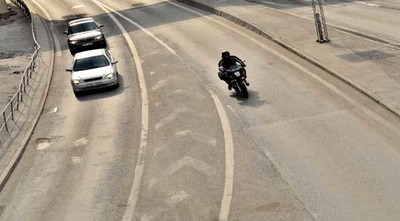
Photo courtsey of http://destinationsafety.com/share-the-road-with-motorcycles/
May is Motorcyle Awarness Month and although THE Motorcycle Lawyer encourages drivers to watch for motorcyclists every single day, he wants to honor this month by asking all drivers to observe these 5 tips:
#5: The road is not a race track. You have nothing to prove, so don't try. If you hurt or kill a motorcyclist because you were trying to challenge them with your car, you'll probably never forgive yourself. Remember, even the slightest contact with a motorcycle can be fatal, so don't risk it.
#4: Back it up! Following too close is a bad idea no matter what's in front of you, but it's especially dangerous if you're tailgating a motorcycle. There's no such thing as a minor “fender bender” if you hit a motorcycle, so please back off.
#3: Don't crowd a motorcyclist. Sometimes, bikers need to move laterally within a lane to avoid debris; stuff that wouldn't affect a car can be a big problem on a motorcycle. Motorcyclists have the right to use the entire lane… let them!
#2: Look, then look again. Be extra careful this time of year if you live in a colder climate; you might not be used to seeing motorcycles on the road again. Taking the time to double check before moving could be a life-or-death decision. Check your blind spots. Signal. In other words, be a good driver.
#1: See the motorcyclist. A motorcycle doesn't ride itself, there's a person on that bike; someone who has a family and a job and a reason to be on the road. See them, and do your part to keep them safe.
|
February 4th, 2014 at 3:05 pm
There are two-wheeled motorcycles, three-wheeled motorcycles and motorcycles with sidecars, but have you ever seen a one-wheeled motorcycle?

Well, you have now. This one-wheeled motorcycle prototype is called RYNO. It has been in construction for seven years by Chris Hoffman. RYNO is a single-wheeled, zero-emissions motorcycle that uses similar, but more advance technology as Segway.
Hoffman started developing RYNO after his daughter saw a one-wheeled motorcycle in a video game and asked if he could build one. And he did.
Even though RYNO is still a prototype, it may be available later this year. It will cost about $5,295 from a facility outside of Portland, Oregon. Hoffman and his team are in the process of gathering nationwide dealers who will allow potential customers to try out RYNO for themselves.
Click here to watch the RYNO in action.
|


 |
| 

